Family Budget Philippines: How to Run a Household Budget That Works for Everyone
Many earners, many needs, one household. How Filipino families can build a budget that covers food, school, bills and lola's meds without anyone feeling left out.
 By the Iponista team · July 1, 2026 · 5 min read

In many Filipino homes, money doesn't belong to one person. There's the parents' sahod, maybe an older sibling's income, padala from a tita abroad, lola's pension, a small sari-sari store at the front of the house. And the expenses are just as shared: food for six, tuition for two, Meralco, water, lola's maintenance meds, the occasional emergency. Running a family budget in the Philippines is less like a spreadsheet and more like steering a jeepney full of passengers. This guide shows how to make it work, step by step, without anyone feeling left out.
Why a family budget is different
A personal budget only has to satisfy one person. A household budget has to balance different incomes, different needs and different ideas about what's "important." It also has to handle the unpredictable: school contributions announced on Friday, a relative who needs help, a broken appliance.
That's exactly why a written plan matters more for families. Without one, decisions happen in the moment, usually by whoever is holding the wallet, and the same arguments repeat every month.
Step 1: List every source of household income
Write down all the money that comes into the household each month, and when it arrives:
- Salaries (per kinsenas or monthly)
- Padala from family abroad
- Pensions, from SSS or elsewhere
- Business or side income
- Regular support from relatives
- Government assistance, if any
Include the dates. A family budget works best when it follows the rhythm of when money actually lands.
Step 2: List fixed and variable expenses
Split household costs into two groups:
Fixed (same amount, predictable)
- Rent or housing loan amortization
- Internet and phone plans
- Tuition installments
- Insurance premiums
- Loan payments
Variable (changes month to month)
- Food and groceries
- Electricity and water
- Transport and fuel
- Medicine and check-ups
- School projects and contributions
- Household items
Fixed costs are easy to plan. Variable costs are where savings hide. Food and electricity in particular respond well to small changes; our guides on cheap ulam ideas and lowering your Meralco bill are good places to start.
Step 3: Decide how everyone contributes
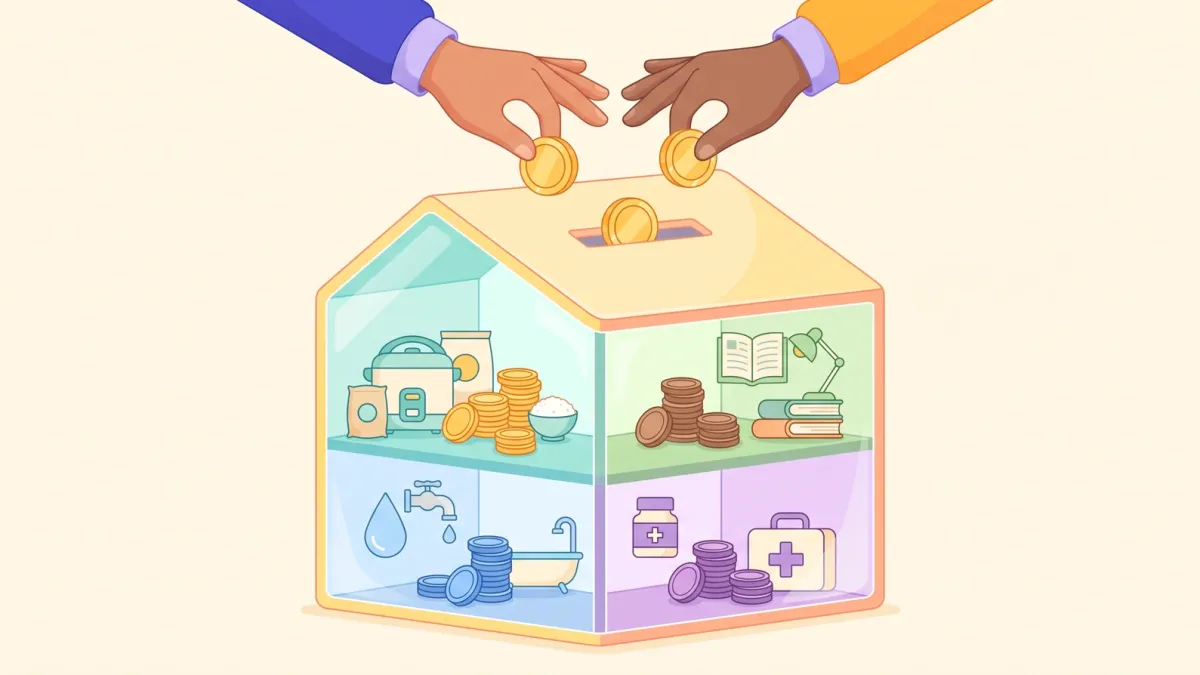
When several people earn, agree clearly on who pays for what. Common approaches:
- One pot: everyone contributes an agreed amount to a shared household fund, and shared bills are paid from it.
- Assigned bills: one person covers rent, another covers food, another covers utilities.
- Proportional: each earner contributes a share based on income, so higher earners give more but everyone keeps some personal money.
Whatever you choose, write it down and review it when someone's income changes. Unspoken arrangements are where family resentment grows.
Step 4: Build the family budget around paydays
Assign each expense to the payday that comes right before its due date. If most big bills fall on one cutoff, set aside part of the lighter payday for them. Our kinsenas budgeting guide explains this in detail, and it works for households with several paydays too. Just put everyone's pay dates on one calendar.
A simple family budget template might look like this:
| Category | Who pays | Paid from |
|---|---|---|
| Rent | Parent 1 | 30th sahod |
| Groceries | Shared pot | Both paydays |
| Electricity and water | Parent 2 | 15th sahod |
| Tuition | Shared pot | Per installment |
| Lola's medicine | Older sibling | 15th sahod |
| Savings | Everyone | Every payday |
Plan for school and health, the two big surprises
School and health costs are the two areas where Filipino families most often get caught off guard.
- School: list the predictable costs, like enrollment, uniforms, supplies and field trips, and save for them monthly in a sinking fund. Leave a small buffer for surprise projects.
- Health: know what your PhilHealth coverage includes for your dependents, keep maintenance medicines in the regular budget, and build an emergency fund for hospital visits. Our lesson on health emergencies and insurance covers what else to prepare.
Supporting extended family
For many Filipino families, the budget includes relatives outside the household: parents in the province, siblings in school, a relative in the hospital. Helping is part of who we are, and it deserves a planned place in the budget:
- Set a monthly amount for family support that the household can sustain.
- Decide together how to handle bigger requests before they happen.
- Keep the household's own emergency fund protected, so helping others doesn't leave your own family exposed.
If one person carries most of this load, the lesson on the breadwinner squeeze is worth reading together.

Include the kids
Children learn money from watching. Involving them, in age-appropriate ways, helps the budget and teaches them for life:
- Give school-age kids a small allowance to manage, with an alkansya for savings.
- Let them help plan one week's meals or the grocery list.
- Talk about choices out loud: "We're not buying this now because we're saving for enrollment."
When money is tight this month
Every family has months when income drops or costs spike. When that happens:
- Protect the essentials first: food, rent, utilities, medicine and school.
- Pause the extras temporarily: subscriptions, eating out, non-urgent purchases.
- Talk to creditors early if a loan payment will be late. Many lenders offer arrangements if you ask before missing a payment.
- Use the emergency fund for real emergencies, and plan how to refill it.
- Check available help. Some families qualify for government assistance programs through the Department of Social Welfare and Development.
Tight months are easier when the whole family knows the plan. Kids handle "we're saving this month" much better than unexplained no's.
A payday family check-in
The simplest habit that keeps a family budget working is a short check-in every payday. Fifteen minutes is enough:
- What money came in?
- Which bills are due before the next payday?
- How much goes to savings?
- Any upcoming school, health or family expenses?
- Is there room for a small family treat?
Keep it calm and short. The goal isn't to blame anyone for overspending; it's to agree on the next two weeks.
Review the family budget every few months
Families change: a child starts school, someone gets a new job, a relative moves in, prices go up. Every three months, look at the budget again together. Update the income list, adjust the food and utilities amounts to what you actually spend, and check that savings and the emergency fund are still growing. A budget that changes with your family is one your family will keep using.
Keep the whole household visible
A family budget works best when everyone can see the same numbers. In Iponista, the person managing the household money can add every wallet, including cash, GCash, bank accounts and the shared pot, set bills with reminders before they're due, and see spending by category. Kinsenas budgets show exactly how much is left for food and extras until the next payday.
Start with one honest family check-in this payday, then set up your household budget in Iponista. A family that plans together stresses less together. For couples working through this for the first time, our budgeting for couples guide is a good companion.
This article is for education and general guidance, not personal financial advice.
Frequently asked questions
How do you make a family budget?
List all household income, list fixed costs like rent and bills, estimate variable costs like food and transport, set aside savings, then assign each expense to the payday before it's due. Review it together every payday.
What should a Filipino family budget include?
Housing, utilities, food, transport, school costs, health and medicine, family support, debt payments, savings and an emergency fund, plus a small amount for family fun.
How do we budget when several family members earn?
Agree on how much each earner contributes to shared household costs, keep a shared pocket for common bills, and let each person keep some personal money. Proportional contributions often feel fairest.
How much should a family save each month?
Whatever is sustainable, even 5% to start. The first goal is an emergency fund that covers at least one month of basic household expenses.